The Method for the  Golden Age (U8–U13)
From the Game to the Player
Course on line · Youth Academy
Questo è un segnaposto del codice personalizzato. Passa ad Anteprima o pubblica la pagina per vedere come funziona il codice. Fai doppio clic per modificare
<script src="https://cdn.paddle.com/paddle/v2/paddle.js"></script> <script> Paddle.Initialize({ token: 'live_a6808dc48511aaa9a8c61b22487' }); // Aggiorna il prezzo dinamico su tutti i pulsanti con classe "paddle-price-btn" Paddle.PricePreview({ items: [{ priceId: 'pri_01m0hzsctxw9rv6z9gym01n56q', quantity: 1 }] }) .then((result) => { const priceText = result.data.details.lineItems[0].formattedTotals.total; const buttons = document.querySelectorAll('.paddle-price-btn'); buttons.forEach(btn => btn.innerText = 'Buy Now - ' + priceText); }) .catch((error) => console.error(error)); function acquistaU8U13() { Paddle.Checkout.open({ items: [{ priceId: 'pri_01m0hzsctxw9rv6z9gym01n56q', quantity: 1 }] }); } </script>
Every era of football shares one thing in common: the constant shrinking of space and time available to players. Added to this is the defining trait of modern football: a player's ability to make the difference individually, but also within team mechanics.

For these reasons, starting from the Golden Age — when children begin pairing good technical ability with the capacity to read the game — it is possible, and necessary, to start developing their football IQ: their game intelligence.

Why football intelligence is essential
A highly skilled player technically, but unable to choose and execute the right play at the right moment, is a player who falls short of his potential.
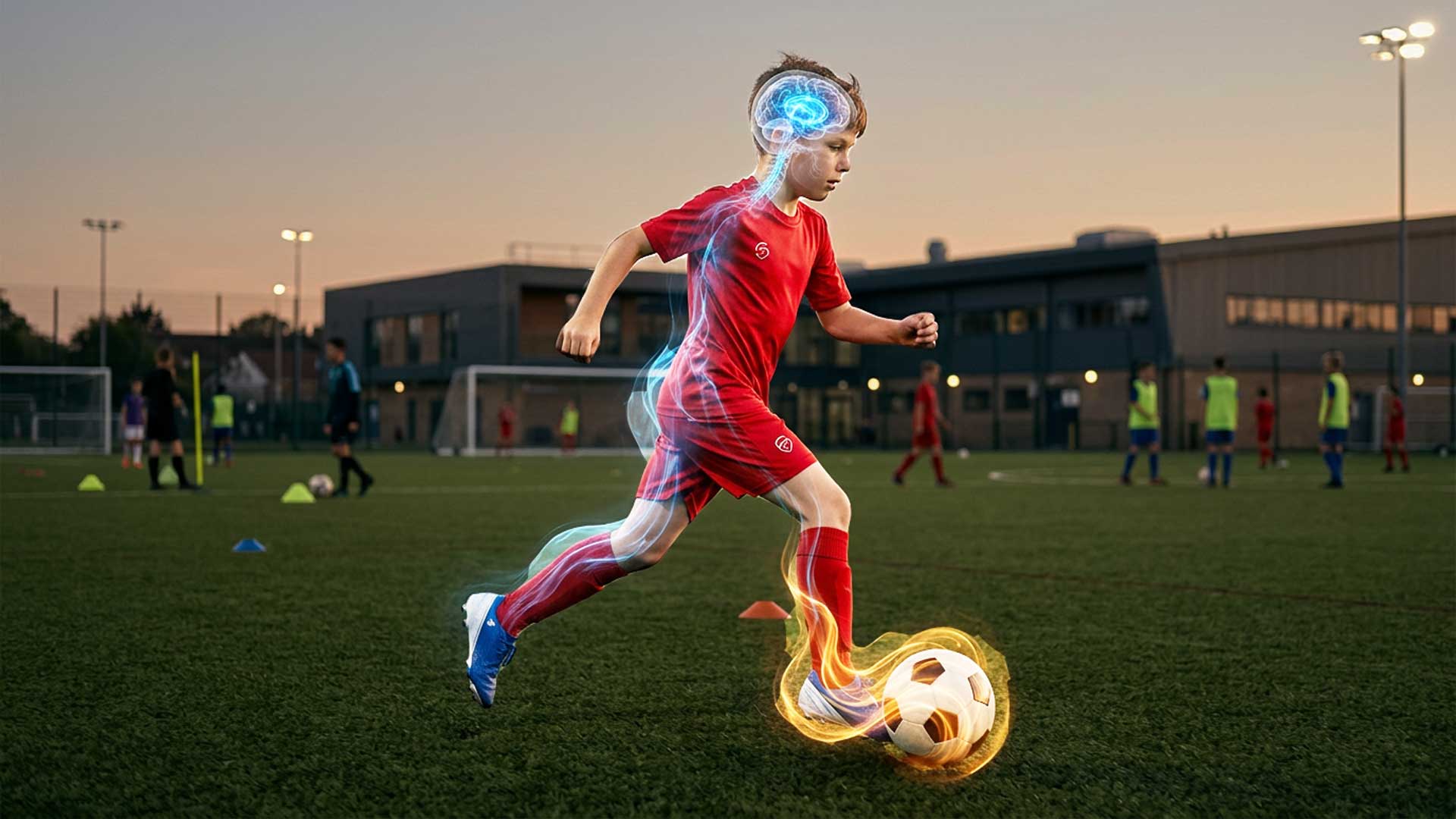
Elite performance is driven by cognitive efficiency. A player who can recognize and anticipate the game has an edge the moment he needs to decide and execute. 
Scanning doesn't just mean turning your head — it means processing a set of information that helps read and anticipate how the play will unfold. A few examples:

  • Defensive body angles and lines
  • Passing speed and trajectories
  • Space "in the shadows" of play
(and more — this is exactly what the course teaches you to catalogue and train systematically)

All of this translates into major advantages in the execution phase.
Reading the game doesn't only mean choosing the best play when in possession of the ball. It also means occupying the best position relative to the team's collective shape and the opponent's — a yard of advantage and an open body posture can make the difference in how play develops after receiving the ball.

This is just to illustrate how much the development of football intelligence — combined with expanding the player's technical toolkit, trained ambidextrously — is the foundation of the development process for Golden Age players.
Developing football intelligence and the fundamentals of players from the Golden Age
"Without effective work in this age group, you lose the chance to accelerate development in 11-a-side football, when focusing on detail and on the components most closely tied to performance becomes the priority".
Massimo Lucchesi
You coach players between 8 and 13 years old, and you know this dilemma well:
  • Relying mostly on isolated technical drills makes players look sharp... in training. Then on match day, under pressure, that technique disappears. 
  • Relying mostly on situational, game-based exercises trains decision-making, but on its own isn't enough to develop talent as a whole. 
THE PROBLEM EVERY U8–U13 COACH FACES
"The problem isn't technique, or decision-making in isolation. It's the lack of an integrated method that develops both components logically, effectively, and consistently".
Massimo Lucchesi
What you just read — reading the game before touching the ball, choosing the right play, executing it precisely — has a precise name in the method, and it can be trained systematically, not left to chance: Scan, Choose, Execute.
And there's one element almost no coaching course teaches you to manage: the player's cognitive bandwidth.

Every player — from a child to a professional — has their own limited amount of mental resources available on the pitch. If the training environment is too chaotic and the player has no clarity on what to focus on, that bandwidth gets overloaded.
Reading the game shuts down, and technical execution goes with it. 
The coach's job isn't just to "propose drills" — it's to give players the tools to break down the complexity of the game and to dose the complexity of the stimuli (working with space, time, and rules), so this ability is genuinely trained rather than burned out.
The talent chain: Scan → Choose → Execute
 SCAN 
CHOOSE
EXECUTE
"Developing a player's football IQ from the Golden Age isn't optional — it's essential. A player who scans and decides before receiving the ball can execute in as little as half a second, with a quality and pace the opponent simply can't react to. A player who only starts scanning after receiving it can take up to a second and a half — and that's exactly when pressure arrives to take away his time and space. Half a second versus a second and a half: that one-second gap is what separates a professional from an amateur".
Massimo Lucchesi
The course is divided into 6 video modules, following the same architecture the method was built on and has already been validated with on the pitch, in professional European academies:
  • Module 1 — The Player: Cognitive and executive profiling. The play triad (Scan, Choose, Execute) and managing cognitive bandwidth.
  • Module 2 — Developing Technical Skills: Cataloguing the fundamentals and mapping the duels.
  • Module 3 — Developing Football IQ: Order as a chaos-reducer. How to help players recognize the game, freeing up individual cognitive bandwidth and maximizing the effectiveness of the technical action.
  • Module 4 — Teaching Objectives and Method: The key steps to integrate technical skill training with football intelligence training, removing improvisation from weekly and seasonal planning.
  • Module 5 — Building the Training Session: From cataloguing exercises to building the training plan — how to work logically and, above all, effectively.
  • Module 6 — Planning: Distributing objectives and achieving them through a staged learning program.
COURSE STRUCTURE
How the online course is organized
The U8–U13 course gives you the tools to build, step by step, the foundation on which all of the player's later development is based:
  • Profiling the football competencies of players in this age group 
  • The map of technical skills to teach, in the right order and without improvisation 
  • Cataloguing the fundamental duels (offensive 1v1, defensive 1v1, back-to-goal, lateral) 
  • Organizing play in 7-a-side format, consistent with this age group 
  • Breaking down and recognizing "games within the game" — the typical situations a young player needs to learn to recognize 
  • Cataloguing training tools specific to the 8–13 age range 
  • How to actually build a session that trains scanning, choosing and executing together 
  • How to distribute objectives across short- and long-term planning 
What you'll take home, ready to apply next Monday
Without these prerequisites, the entire training and development process is compromised — even when 8-year-olds are playing 7-a-side.
The Method for the Golden Age (U8–U13)
From the Game to the Player
Course on line · Youth Academy
What isn't built now will cost you time — and quality — later. This method gives you a clear, step-by-step way to start today.
The Golden Age can't be postponed.
Questo è un segnaposto del codice personalizzato. Passa ad Anteprima o pubblica la pagina per vedere come funziona il codice. Fai doppio clic per modificare
<div style="text-align: center; margin: 20px 0;"> <button class="paddle-price-btn" type="button" onclick="acquistaU8U13()" style="background-color: #ff0000; color: #ffffff; padding: 16px 36px; font-size: 18px; font-weight: bold; border: none; border-radius: 6px; cursor: pointer;"> Buy Now - €149 </button> </div>
  • Founder of Allenatore.net, the first European portal for coaches (since 2000), and creator of Newsoccerdrills.com
  • Author of Organizzazione Liquida, awarded Best Publication of the Year for Coaches (Ghirelli Award — FIGC), translated into English, German, Russian, Romanian, Greek, Arabic and Czech
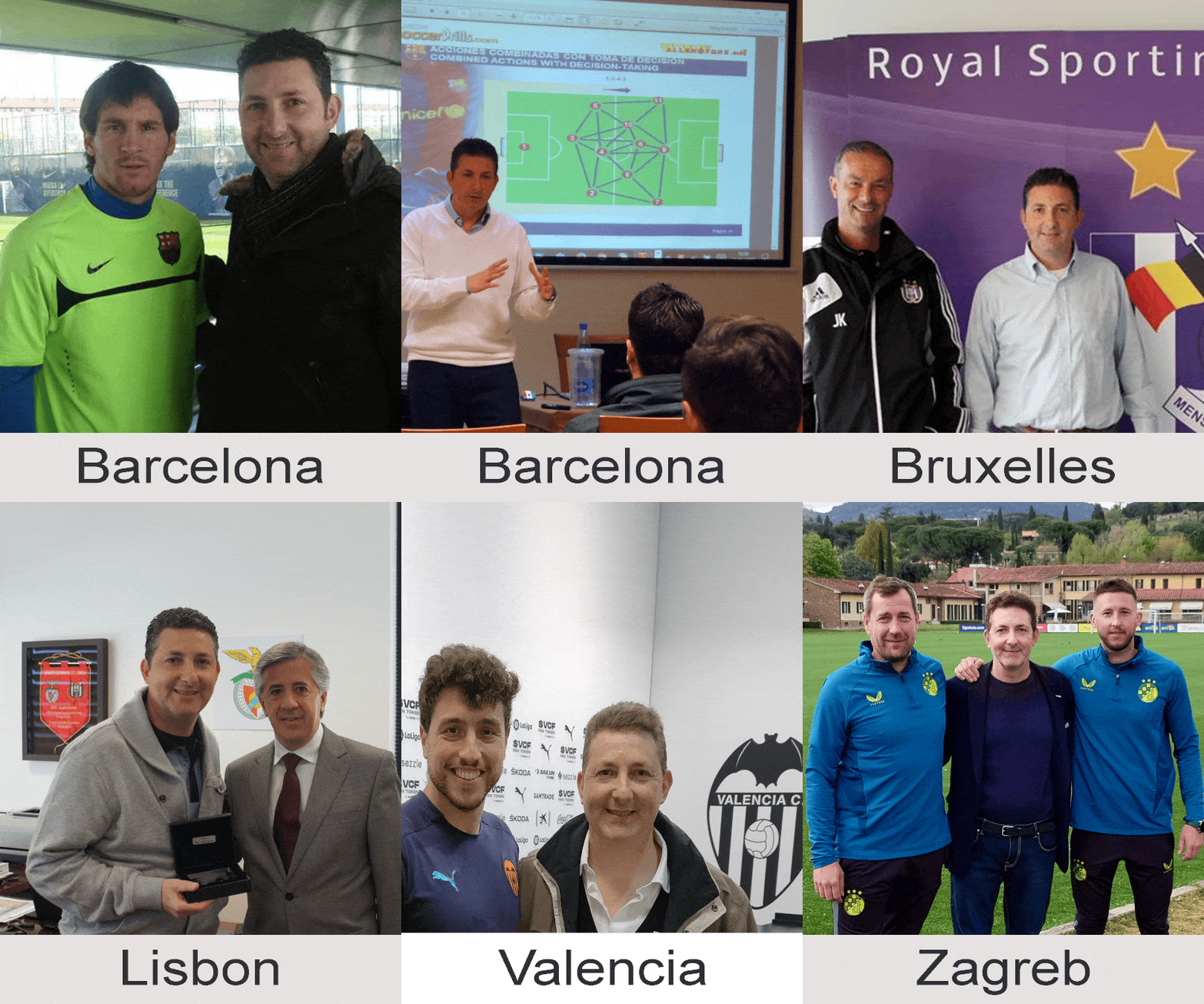
  • Designed coaching courses for Europe's top academies: Anderlecht, Espanyol, Barcelona, Dinamo Zagreb, Valencia, and 10+ years at Benfica's Seixal Campus
  • Lecturer at UEFA Pro coaching courses for Romania, Poland, and Latvia; 100+ seminars in Italy, 40+ across Europe
  • Closely studied the on-field work of Guardiola, Ancelotti, Sarri, Nagelsmann, Zeman, De Zerbi, Fabregas, Spalletti, and more
WHO IS MASSIMO LUCCHESI?
20+ years training coaches across Europe's top academies
Because there's no single "European method" — Spain, Portugal, Belgium, and every other football nation follows their own philosophy. Massimo Lucchesi has studied them all, directly, from the inside.
"Over the years I've had the chance to observe them from the inside — not from a distance, not from books, but sitting in the same rooms, on the same pitches, talking directly with the people who apply these methods every day. What follows isn't theory. It's what I've seen, what I've heard, and — above all — what those experiences have taught me, and what might be useful to you too".
Massimo Lucchesi
The method wasn't built at a desk. It was born from over twenty years of direct observation of the work carried out at some of Europe's most prestigious youth academies — Anderlecht, Espanyol, Barcelona, Dinamo Zagreb, Valencia, Benfica. That knowledge, gathered on the pitch, was developed into a structured, replicable method — one that also works for medium and small clubs.

But a method is only as good as its practical proof. That's why, between 2014 and 2017, Massimo Lucchesi put himself on the line as methodology director of CGC Capezzano Pianore — a tiny club, in the province where he lives: a small laboratory and a real-world testing ground to find out whether, and how, the method actually worked with young players, in day-to-day practice.

The result: several players coached with this approach during those years went on to join professional clubs. Among them, Jacopo Fazzini, born 2003, who today plays in Serie A and is part of the Italian national team setup (Under 21).
A remarkable result, considering a sample of just 300 young players — those who were part of Capezzano's youth sector in those years. 
It's proof that a method built by observing the best in Europe can be adapted and made to work even at a small club, because that's exactly where it was truly tested.
THE FAZZINI CASE STUDY
From a small provincial club to Serie A: how a method is born and proven
Toscanagol.it/
This is the method that made it possible. 
Here's how you can start using it too.
Unlock full access to:
  • Access to the video course The Method (U8–U13), on demand 
  • The 6 modules: The Player, Developing Technical Skills, Developing Football IQ, Teaching Objectives and Method, Building the Training Session, Planning 
  • Downloadable materials: slides from every session 
  • Certificate of participation 
  • Unlimited access to the course content over time
The Method for the Golden Age (U8–U13)
From the Game to the Player
Course on line · Youth Academy
Questo è un segnaposto del codice personalizzato. Passa ad Anteprima o pubblica la pagina per vedere come funziona il codice. Fai doppio clic per modificare
<div style="text-align: center; margin: 20px 0;"> <button class="paddle-price-btn" type="button" onclick="acquistaU8U13()" style="background-color: #ff0000; color: #ffffff; padding: 16px 36px; font-size: 18px; font-weight: bold; border: none; border-radius: 6px; cursor: pointer;"> Buy Now - €149 </button> </div>
14-Day Money-Back Guarantee

Try the course with complete confidence. If within 14 days of purchase you feel it isn't the right fit, just send us an email and you'll get a full refund — no questions asked. We stand behind the value of this method.
Who is this course for? For coaches working with pre-competitive teams, ages 8–13 (7-a-side format), who want a structured method to develop game intelligence and technique together.

I coach competitive age groups — is there a course for me? Yes. If you work with competitive teams (U14–U19, 11-a-side), the same method is available in a dedicated course, adapted to that age group's technical objectives and game format.

What's the difference with the U14–U19 course? The methodological core is the same — developing the Scan-Choose-Execute process as the foundation of football intelligence. What changes are the technical objectives (position-specific skill maps), the game format (11-a-side), and how player profiling is adapted to this older, more competitive age group.

Do I need prior coaching experience? Some coaching experience helps, but it's not a strict requirement. The course is structured step by step, so even less experienced coaches can follow and apply the method effectively.

Is the course in English? Yes, all video lessons and materials are in English.

How long do I have access to the content? Access to the course content is unlimited over time — you can revisit the videos and materials whenever you need to.

How does payment work? Payment is processed securely through Paddle. The price is automatically shown in your local currency, at the correct amount for your country.

What if the course isn't right for me? You're covered by our 14-day money-back guarantee. If it's not the right fit, just email us for a full refund — no questions asked.

F.A.Q.
WHATSAPP: +39 371 422 6564
For further information or inquiries, contact us by email at staff@allenatore.net or via WhatsApp
ALLENATORE.NET S.A.S. - VAT n°: 02419180464
Italy
This site uses cookies to improve your experience. Read our Cookie Policy
Payments and order fulfillment are processed by Paddle.com (Merchant of Record). By placing an order, you agree to Paddle’s Buyer Terms and Allenatore.net’s Terms of Service